
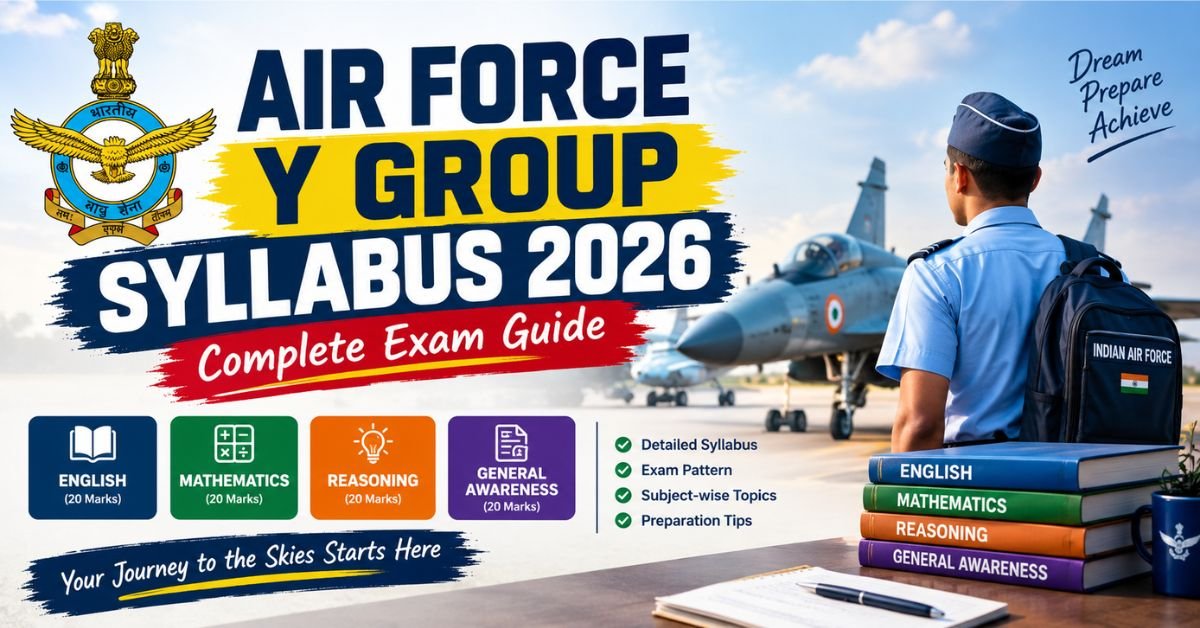
The Air Force Y Group syllabus is the starting point for every candidate preparing for the Indian Air Force’s non-technical Agniveervayu recruitment. If you’re searching for the Air Force Y Group syllabus with exact subject-wise topics, exam pattern, cutoff trends, and salary details, this guide covers everything in one place, verified against the latest official exam pattern. Whether you’re just starting preparation or revising before the exam, this breakdown will save you hours of scattered research.
This guide is compiled and cross-checked against official Indian Air Force recruitment patterns, current Agnipath scheme salary structures, and recent Phase 1 cutoff trends, and it is updated to reflect the latest recruitment cycle so you’re not relying on outdated PDFs.
Air Force Y Group Eligibility Criteria
Before you start preparing on the syllabus, it’s worth confirming you meet the basic eligibility conditions, since these vary slightly by trade within the Y Group.
| Criteria | Requirement |
|---|---|
| Age Limit | 17.5 to 21 years (varies slightly by intake notification) |
| Nationality | Indian citizen as defined under the Citizenship Act |
| Educational Qualification | 10+2 / Intermediate with minimum 50% aggregate marks and 50% in English |
| Gender | Both male and female candidates eligible (trade-dependent) |
| Marital Status | Unmarried at the time of enrolment |
For the Medical Assistant trade specifically, candidates additionally need Physics, Chemistry, and Biology at the 10+2 level, along with English, maintaining the same 50% aggregate and English marks requirement.
Air Force Y Group Exam Pattern at a Glance
Before diving into topics, it helps to understand how the exam is structured. The Air Force Y Group online written test is a single-day, objective-type exam divided into two papers: English and Reasoning & General Awareness (RAGA).
Both papers are compulsory, and candidates must clear the minimum qualifying marks in each section separately, not just the combined total.
| Exam Component | Details |
|---|---|
| Total Questions | 50 |
| Total Marks | 50 |
| Duration | 45 minutes |
| Subjects | English + RAGA (Reasoning, Maths, General Awareness) |
| Marking Scheme | +1 for correct answer |
| Negative Marking | -0.25 for each wrong answer |
| Unanswered Question | No penalty |
| Exam Mode | Online (Computer-Based Test) |
| Selection Stages | Online Test → Physical Fitness Test → Medical Exam |
Air Force Y Group Syllabus 2026 (Subject-Wise)
The syllabus is compact compared to other government exams, but it demands speed and accuracy since you get less than a minute per question on average. Below is the complete subject-wise breakdown.
1. English Syllabus
The English section tests basic language proficiency rather than advanced literature. Expect questions from:
- Comprehension passages
- Grammar rules (tenses, articles, prepositions)
- Vocabulary, synonyms, and antonyms
- One-word substitution
- Sentence correction and sentence rearrangement
- Idioms and phrases
- Spelling and error detection
2. Reasoning Syllabus
Reasoning questions check your logical and analytical thinking speed. Common topics include:
- Numerical series
- Distance and direction sense test
- Coding and decoding
- Number, ranking, and time sequence tests
- Blood relations
- Analogy
- Odd one out
- Non-verbal reasoning (figure-based)
- Mathematical operations and sign-based puzzles
3. Mathematics Syllabus
Mathematics is tested as part of the RAGA paper rather than as a separate subject, but it still carries a meaningful share of questions. Core topics include:
- Ratio and proportion
- Average
- LCM and HCF
- Profit and loss
- Time, speed, and distance
- Percentage
- Simplification of numbers
- Fractions
- Area of triangle, square, and rectangle
- Surface area and volume of cuboid, cylinder, cone, and sphere
- Probability
- Simple trigonometry
4. General Awareness Syllabus
General Awareness covers static GK and current affairs. Focus areas are:
- General science (Physics, Chemistry, Biology basics)
- Civics and Indian polity
- Geography
- History
- Current national and international events
- Sports and defence-related current affairs
Why the Y Group Syllabus Feels Harder Than It Looks
On paper, four subjects packed into 50 questions sounds manageable. In practice, most candidates lose marks not because the topics are difficult, but because of poor time management across sections.
Since English and RAGA both carry separate qualifying cutoffs, a strong RAGA score cannot compensate for a weak English score, and vice versa. This is why balanced preparation across all four areas — not just your strongest subject — is essential for the Air Force Y Group syllabus.
Is There Maths in Air Force Y Group?
Yes, mathematics is part of the Air Force Y Group syllabus, but it is not a standalone paper. Maths questions are embedded within the RAGA (Reasoning & General Awareness) section alongside reasoning and general knowledge questions.
This is an important distinction that many first-time aspirants miss. You won’t see a separate “Mathematics” paper on your admit card, but a noticeable portion of the RAGA questions will be numerical or maths-based.
Table: Key Mathematics Topics Tested in RAGA
| Topic | Typical Question Type |
|---|---|
| Percentage & Profit-Loss | Calculation-based word problems |
| Ratio, Proportion & Average | Direct formula application |
| Time, Speed & Distance | Word problems involving trains, boats, speed |
| LCM, HCF & Simplification | Basic number system problems |
| Mensuration (Area & Volume) | Geometry-based calculation |
| Probability & Simple Trigonometry | Conceptual, formula-based questions |
The difficulty level is generally equivalent to Class 10 mathematics, so candidates with a strong Class 10 foundation can clear this section comfortably with consistent practice.
Air Force Y Group Selection Process
Clearing the syllabus is only the first hurdle. The complete selection process has three stages, and candidates must clear each one sequentially.
- Online Written Test (Phase 1): Tests English and RAGA as described above.
- Physical Fitness Test (PFT) and Adaptability Test: Includes a timed run, push-ups, sit-ups, and squats, along with psychological adaptability screening.
- Medical Examination: Conducted by Air Force medical authorities as per prescribed physical and medical standards.
Only candidates who clear all three stages, in order, are placed on the final merit list for training allotment.
What Is the Cutoff of the Air Force Y Group?
The Air Force Y Group cutoff is the minimum score required in the Phase 1 written exam to qualify for the Physical Fitness Test. It changes every recruitment cycle based on several factors.
Cutoff marks are influenced by:
- Number of vacancies announced for that intake
- Total number of candidates appearing
- Overall difficulty level of that year’s paper
- Normalization applied across multiple exam shifts
Table: Air Force Y Group Cutoff Trend (Out of 50 Marks)
| Recruitment Cycle | Approximate Cutoff (Marks) |
|---|---|
| Recent cycles (general trend) | 32–38 marks |
| High-vacancy intakes | 28–32 marks |
| Low-vacancy / high-competition intakes | 36–40 marks |
These figures are indicative trends based on recent recruitment cycles and can shift year to year, so always cross-check the officially released cutoff after each exam through the recruitment authority’s result notification.
Scoring above 38–40 out of 50 is generally considered a safe zone regardless of vacancy fluctuations.
What Is the IAF Salary (Air Force Y Group)?
Air Force Y Group recruitment currently happens under the Agnipath scheme, so selected candidates join as Agniveervayu for a four-year tenure rather than as permanent Airmen from day one.
The monthly package increases every year of service, and a lump-sum exit benefit is paid at the end of the four-year term.
Table: IAF Agniveervayu (Y Group) Salary Structure
| Year of Service | Monthly Package (Approx.) | In-Hand Component (Approx.) |
|---|---|---|
| Year 1 | ₹30,000 | ₹21,000 |
| Year 2 | ₹33,000 | ₹23,100 |
| Year 3 | ₹36,500 | ₹25,580 |
| Year 4 | ₹40,000 | ₹28,000 |
In addition to the monthly package, Agniveervayu personnel receive:
- Seva Nidhi Package: A tax-exempt lump sum of approximately ₹11.71 lakh, paid on completion of the four-year tenure (built from monthly contributions plus matching government contribution with interest).
- Risk and hardship allowance where applicable.
- Group insurance cover during the service period.
- Dress and travel allowances as per government norms.
Candidates who perform well during their four-year tenure may also be considered for permanent retention in the Air Force, subject to vacancies and performance evaluation, typically around 25% of a batch.
Air Force Y Group Job Roles and Career Growth
The Y Group is the non-technical wing of Air Force recruitment, covering a wide range of administrative, medical, and support trades. Understanding these roles helps you see where the syllabus is eventually applied on the job.
Common trades under Y Group include:
- General Duty (GD) — security and general administrative duties
- Medical Assistant — support roles in Air Force hospitals and medical units
- Administrative Assistant — office and documentation management
- Logistics Assistant — supply chain and inventory management
- Accounts Assistant — pay, accounts, and financial record-keeping
- IAF Police & Security — base security and law enforcement duties
- Meteorological Assistant — weather observation and reporting support
- Musician — Air Force band and ceremonial duties
Each trade has its own training module after selection, but all candidates go through the same Phase 1 written exam based on the syllabus discussed above, followed by trade-specific training at the respective training establishment.
Documents Required for Air Force Y Group Recruitment
Keep these documents ready well before your exam and PFT dates to avoid last-minute rejection:
- 10th and 12th mark sheets and certificates (originals plus photocopies)
- Valid photo identity proof (Aadhaar card, PAN card, or passport)
- Recent passport-size photographs as per notification specifications
- Caste/category certificate, if applicable
- Domicile certificate, where required
- Character certificate from school/college or a gazetted officer
Physical Fitness Test (PFT) Requirements
The PFT is conducted only for candidates who clear the written cutoff. Basic requirements include:
- 1.6 km run: To be completed within a specified time limit.
- Push-ups, sit-ups, and squats: A minimum number within a set time frame.
- Height and chest measurements: As per the minimum physical standards notified for the recruitment cycle.
Physical preparation should ideally start alongside academic preparation, not after clearing the written exam, since time between the written result and PFT date is often limited.
Best Preparation Tips for Air Force Y Group Syllabus
Use this practical strategy to prepare efficiently within the compact syllabus:
- Start with NCERT basics for Maths (up to Class 10) and General Science (Class 9–10), since most questions are foundational rather than advanced.
- Build a daily current affairs habit covering the last six months before your exam date.
- Practice previous years’ RAGA papers to understand the exact difficulty level and question pattern.
- Time yourself strictly — with 50 questions in 45 minutes, speed matters as much as accuracy.
- Revise English grammar rules rather than only memorising vocabulary lists.
- Attempt full-length mock tests weekly to build exam-day stamina and reduce negative marking losses.
- Begin PFT training early, alongside academic revision, not after the written exam.
Common Mistakes to Avoid While Preparing
Even well-prepared candidates lose marks due to avoidable errors. Watch out for these:
- Ignoring English while over-focusing on Maths: Both papers have separate cutoffs, so neglecting English can disqualify an otherwise strong candidate.
- Skipping current affairs revision until the last week: General Awareness needs consistent, ongoing revision, not last-minute cramming.
- Not practicing under timed conditions: 45 minutes for 50 questions leaves little room for slow calculation; untimed practice creates a false sense of readiness.
- Delaying physical fitness preparation: Starting PFT training only after the written result often leaves too little time to build adequate stamina.
- Relying on guesswork without preparation: With 0.25 negative marking per wrong answer, random guessing on multiple questions can silently pull your score below the cutoff.
Frequently Asked Questions (FAQs)
Is there maths in Air Force Y Group?
Yes, mathematics is included within the RAGA (Reasoning & General Awareness) paper of the Air Force Y Group syllabus. It is not a separate subject, but topics like percentage, profit-loss, time-speed-distance, and mensuration are regularly tested.
What is the cutoff of the Air Force Y group?
The cutoff generally ranges between 28 and 40 marks out of 50 in the Phase 1 written exam, depending on the number of vacancies, competition level, and difficulty of that year’s paper. It is released officially after each recruitment cycle.
What is the IAF salary?
Under the Agnipath scheme, Air Force Y Group (Agniveervayu) candidates receive a monthly package starting at approximately ₹30,000 in Year 1, rising to ₹40,000 by Year 4, along with a tax-free Seva Nidhi package of around ₹11.71 lakh at the end of the four-year tenure.
How many questions are there in the Air Force Y Group exam?
The exam consists of 50 questions worth 50 marks, to be completed in 45 minutes.
Is there negative marking in the Air Force Y Group exam?
Yes, 0.25 marks are deducted for every wrong answer, while unattempted questions carry no penalty.
What subjects are covered in the Air Force Y Group syllabus?
The syllabus covers English and RAGA (Reasoning, Mathematics, and General Awareness), followed by a Physical Fitness Test and Medical Examination in later stages.
Is the Air Force Y Group exam conducted online or offline?
It is conducted online as a Computer-Based Test (CBT), which means results and marks calculation are typically faster than paper-based exams.
Can female candidates apply for Air Force Y Group?
Yes, female candidates are eligible for most Y Group trades, subject to trade-specific and physical eligibility conditions mentioned in the official recruitment notification.
Is there a difference between Air Force Y Group and Agniveervayu? No, current Air Force Y Group recruitment is conducted under the Agnipath scheme, meaning selected candidates join as Agniveervayu for an initial four-year tenure, with the possibility of permanent retention based on performance.
Conclusion
The Air Force Y Group syllabus is compact but competitive, covering English, Reasoning, Mathematics, and General Awareness within a strict 45-minute window. Understanding exactly where maths fits into the paper, tracking realistic cutoff trends, and knowing the current Agniveervayu salary structure helps you set the right preparation targets from day one.
A focused, section-wise study plan works far better than trying to cover everything at once. Spend the first few weeks building your Maths and English fundamentals, then shift toward daily current affairs and full-length timed mocks as your exam date approaches.
Combine this with early physical fitness training, since PFT preparation started late is one of the most common reasons capable candidates miss selection despite clearing the written cutoff. Revise consistently using previous years’ patterns, track your mock test scores against the cutoff trends shared above, and walk into the exam hall with a clear, practiced strategy rather than last-minute cramming.
Preparation built this way — subject-balanced, time-bound, and physically ready — gives you the best realistic chance of clearing the Air Force Y Group exam in your very first attempt.
Official Sources and Further Reading
- Indian Air Force – Official Website
- Agnipath Scheme – Ministry of Defence, Government of India
- Agnipath Vayu Official Recruitment Portal
- Press Information Bureau, Government of India
You may also like : Top 10 Digital Marketing Institute in India, Best Digital Marketing Institute in India