
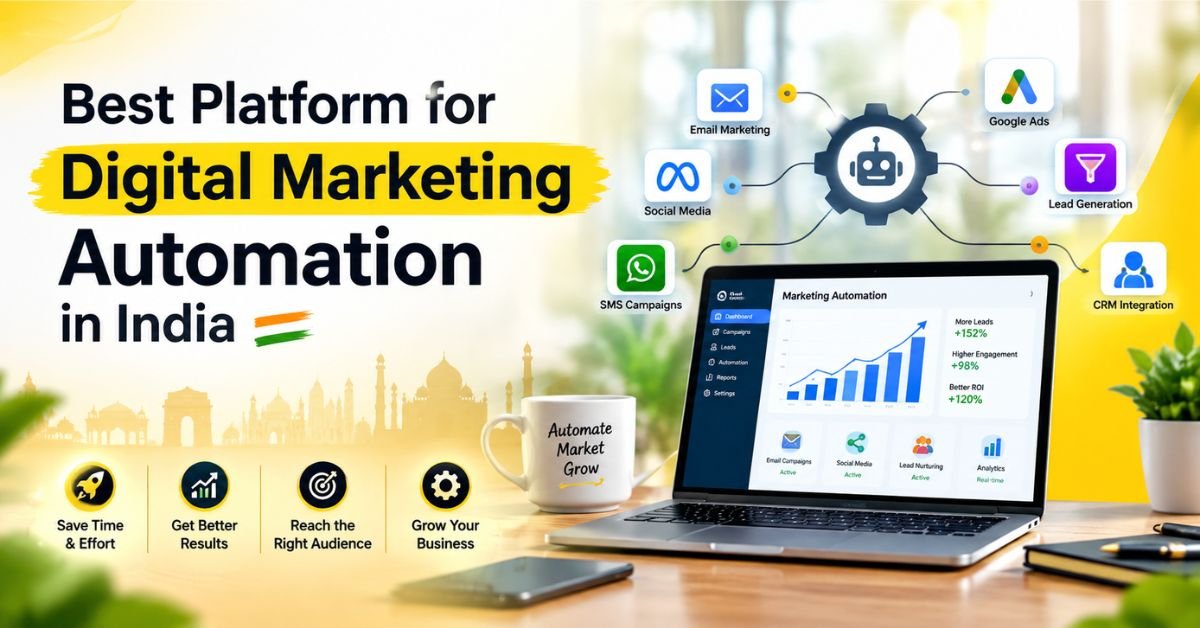
Choosing the best platform for digital marketing automation in India is one of the most important growth decisions a business can make in 2026. With over 958 million active internet users in the country, brands that automate email, SMS, and WhatsApp campaigns convert faster than those relying on manual outreach. This guide breaks down the best platform for digital marketing automation in India, how to choose one, and what really drives ROI.
What Is Digital Marketing Automation?
Digital marketing automation is the use of software to run repetitive marketing tasks — emails, SMS, WhatsApp messages, push notifications, lead scoring, and ad retargeting — without manual effort on every send.
Instead of a marketer manually emailing every lead, an automation platform triggers messages based on user behavior. A cart abandonment, a form fill, or a website visit can all launch a pre-built workflow automatically.
For Indian businesses, this matters more than ever. Customers expect instant, personalized replies across email, SMS, and WhatsApp — and manual teams simply cannot keep pace with that volume.
Core Components of a Marketing Automation Platform
- Email marketing automation — drip sequences, newsletters, transactional emails
- SMS and WhatsApp automation — India’s most-used engagement channels
- Lead scoring and CRM integration — ranking leads by intent and readiness to buy
- Behavioral triggers — actions based on browsing, purchase, or app activity
- Analytics and attribution — tracking what channel actually drove revenue
- AI-powered personalization — dynamic content based on user segments
Why Indian Businesses Need Marketing Automation in 2026
India’s digital economy has scaled dramatically. According to the Internet in India Report 2025 by the Internet and Mobile Association of India (IAMAI) and Kantar, the country’s active internet user base crossed 950 million in 2025, driven largely by rapid growth in rural connectivity, rising short-video consumption, and increasing adoption of AI. The same report found that rural India accounts for 57% of the country’s active internet users — around 548 million people — with roughly 8% year-on-year growth overall (source: Business Standard / IAMAI-Kantar report).
This growth means three things for marketers:
- Scale is unmanageable manually. A brand growing from 1,000 to 1,000,000 customers cannot personalize every message by hand.
- Mobile and WhatsApp dominate. India is a mobile-first market, and automation platforms that support app pushes, SMS, and WhatsApp workflows see the strongest engagement.
- Compliance is now mandatory. With the Digital Personal Data Protection (DPDP) Act, 2023 now operational, platforms must handle consent and data storage correctly (more on this below).
Key Features to Look for in the Best Platform for Digital Marketing Automation in India
Not every automation tool is built for the Indian market. Before you commit to a platform, check it against this feature checklist.
| Feature | Why It Matters in India |
|---|---|
| WhatsApp Business API integration | WhatsApp is India’s dominant messaging channel for order updates and support |
| SMS + regional language support | Reaches tier 2/3 cities and non-English-first audiences |
| CRM and e-commerce integrations | Connects with Shopify, WooCommerce, Zoho CRM, Salesforce |
| DPDP Act–ready consent management | Avoids compliance penalties under India’s data law |
| AI-based lead scoring | Prioritizes high-intent leads for sales follow-up |
| Affordable, usage-based pricing | Startups and SMEs need pay-as-you-go models, not enterprise-only pricing |
| Local payment gateway (INR billing) | Avoids currency conversion friction for Indian teams |
| Analytics dashboard | Tracks ROI per channel, not just opens and clicks |
Best Platforms for Digital Marketing Automation in India: Comparison Table
Here is a side-by-side comparison of leading marketing automation platforms available to Indian businesses in 2026, based on features, ideal use case, and starting price.
| Platform | Best For | Key Strength | Starting Price (Approx.) |
|---|---|---|---|
| Zoho Marketing Automation | Indian SMEs already using Zoho CRM | Native CRM integration, INR billing | Free tier; paid plans from ₹1,000+/month |
| HubSpot Marketing Hub | Mid-size to enterprise inbound marketing | All-in-one CRM + automation + content tools | Free tier; paid plans from ~$20/month |
| WebEngage | App-first businesses (retail, fintech, travel) | Deep behavioral tracking and personalization | Custom pricing |
| CleverTap | Mobile apps needing lifecycle marketing | Real-time customer engagement analytics | Custom pricing |
| ActiveCampaign | Small businesses needing simple email/SMS automation | Easy-to-build workflows | From $15/month |
| Salesforce Marketing Cloud | Large enterprises with complex journeys | Advanced segmentation at scale | Custom, enterprise pricing |
| Brevo (formerly Sendinblue) | Startups needing email + SMS + WhatsApp in one plan | Multichannel campaigns, transparent pricing | Free tier; paid plans from ₹1,900+/month |
| Mailchimp | Beginners and content-led small brands | Simple templates, easy onboarding | Paid plans from ₹575/month |
Pricing changes frequently — always confirm current rates directly on the provider’s official pricing page before purchasing.
Platform-by-Platform Breakdown
A comparison table gives you the summary. But choosing the best platform for digital marketing automation in India also means understanding what each tool does well, and where it falls short. Here is a closer look at the eight platforms above.
Zoho Marketing Automation
Zoho is one of India’s largest homegrown SaaS companies, and its marketing automation suite reflects that local-first design.
It natively connects with Zoho CRM, Zoho Campaigns, and Zoho Forms, which makes it the simplest option for businesses already inside the Zoho ecosystem. INR billing and India-based support reduce friction for smaller teams.
Where it fits: Indian SMEs that want CRM, email, and lead scoring under one login without paying in dollars.
HubSpot Marketing Hub
HubSpot is widely used by mid-size and growing companies that want inbound marketing, automation, and a CRM in a single platform.
Its workflow builder is visual and beginner-friendly, and the free CRM tier lets small teams start without upfront cost. The trade-off is that advanced automation features sit behind higher-priced tiers, which can get expensive as contact lists grow.
Where it fits: Content-led B2B and B2C brands that want automation tied closely to inbound lead generation.
WebEngage
WebEngage focuses on behavioral and lifecycle marketing for app-first businesses — think fintech apps, OTT platforms, travel booking sites, and e-commerce apps.
It tracks granular in-app and on-site behavior, then triggers personalized journeys across push notifications, email, SMS, and WhatsApp.
Where it fits: Companies with a mobile app as their primary customer touchpoint.
CleverTap
CleverTap is built for real-time customer engagement analytics, particularly for consumer apps that need to reduce churn and increase retention.
Its strength is cohort analysis — understanding how different user segments behave over time — paired with automated re-engagement campaigns.
Where it fits: Mobile-first startups focused on retention marketing rather than pure acquisition.
ActiveCampaign
ActiveCampaign keeps automation simple. Its drag-and-drop workflow builder is one of the easiest to learn, and its pricing is friendly for small businesses.
It combines email, SMS, and basic CRM functionality, though it lacks the deep India-specific features (like native WhatsApp integration) that some local platforms offer.
Where it fits: Small businesses that want reliable email and SMS automation without a steep learning curve.
Salesforce Marketing Cloud
Salesforce Marketing Cloud is built for enterprises running complex, multi-year customer journeys across dozens of segments and channels.
It offers the deepest segmentation, AI-based journey optimization, and integration with the broader Salesforce ecosystem — but it requires a dedicated marketing operations team to run effectively, and pricing reflects that complexity.
Where it fits: Large enterprises and BFSI (banking, financial services, insurance) companies with dedicated marketing technology budgets.
Brevo (formerly Sendinblue)
Brevo bundles email, SMS, and WhatsApp campaigns into one transparent, usage-based pricing model, which suits startups that don’t want to pay separately for each channel.
Its automation workflows are simpler than enterprise tools, but that simplicity is often exactly what early-stage teams need.
Where it fits: Startups that want multichannel automation without a steep price jump.
Mailchimp
Mailchimp remains one of the most recognizable names in email marketing globally, and it’s a natural starting point for beginners and content-led small brands in India.
Its template library and drag-and-drop editor make campaign creation fast, though its automation logic is less advanced than dedicated marketing automation platforms.
Where it fits: Small brands and solo marketers who primarily need email newsletters and basic drip sequences.
How to Choose the Right Platform for Your Business
Picking the best platform for digital marketing automation in India depends on your business size, budget, and channel priorities. Use this step-by-step approach.
Step 1: Define Your Primary Channel
If most of your customer conversations happen on WhatsApp, prioritize platforms with native WhatsApp Business API support. If you rely on email newsletters, an email-first tool like Mailchimp or Brevo may suffice.
Step 2: Match the Platform to Your Team Size
- Solopreneurs and micro-businesses: Look for free tiers (Zoho, Brevo, Mailchimp)
- Growing SMEs: Mid-tier plans with CRM integration (Zoho, ActiveCampaign)
- Enterprises: Full-suite platforms with dedicated support (Salesforce Marketing Cloud, HubSpot Enterprise)
Step 3: Check for DPDP Act Compliance
India’s data protection regime is no longer optional. The Digital Personal Data Protection Act, 2023 was enacted to govern how digital personal data is processed. Per the Ministry of Electronics and Information Technology (MeitY), the framework governs the processing of digital personal data in a way that balances an individual’s right to protect their personal data with the need to process such data for lawful purposes (source: MeitY — Data Protection Framework). Any automation platform you choose must support consent capture, data minimization, and secure storage in line with this law.
Step 4: Test Before You Commit
Almost every platform on this list offers a free trial or freemium tier. Run a 14-day test using real campaign data before signing an annual contract.
Pricing Snapshot: Budget vs. Enterprise Options
| Budget Tier | Platforms | Typical Use Case |
|---|---|---|
| Free / Low-cost (₹0–₹2,000/month) | Zoho Marketing Automation, Mailchimp, Brevo | Solopreneurs, early-stage startups |
| Mid-range ($15–$100/month) | ActiveCampaign, Zoho Campaigns Pro plans | Growing SMEs with 1,000–50,000 contacts |
| Enterprise (Custom pricing) | Salesforce Marketing Cloud, WebEngage, CleverTap | High-volume apps, fintech, retail chains |
Benefits of Marketing Automation for Indian Businesses
- Time savings — automates repetitive tasks like follow-up emails and social posting
- Higher engagement — keeps customers engaged with targeted, timely campaigns
- Better conversion rates — nurtures leads automatically instead of losing them to slow follow-up
- Scalability — the same workflow serves 100 or 100,000 customers without extra staff
- Cross-channel consistency — email, SMS, and WhatsApp messaging stay aligned
Common Mistakes Businesses Make With Marketing Automation
- Over-automating — sending too many messages too fast, which increases opt-outs
- Ignoring data hygiene — outdated contact lists reduce deliverability and campaign accuracy
- Skipping A/B testing — never testing subject lines, CTAs, or send times wastes optimization potential
- Choosing tools based on price alone — the cheapest plan often lacks WhatsApp or CRM integration
- Not reviewing DPDP consent settings — risking non-compliance penalties
Marketing Automation Use Cases by Industry
Different industries in India lean on different automation workflows. Here’s how the best platform for digital marketing automation in India is typically used across sectors.
E-commerce and D2C Brands
E-commerce brands rely heavily on cart-abandonment emails, WhatsApp order updates, and post-purchase upsell sequences. Platforms like Zoho, Brevo, and WebEngage integrate directly with Shopify and WooCommerce to trigger these workflows automatically.
Real Estate
Real estate businesses use lead scoring to identify serious buyers among hundreds of inquiries, then automate follow-up SMS and WhatsApp sequences until a site visit is booked. CRM-linked platforms like Zoho and HubSpot work well here.
BFSI (Banking, Financial Services, Insurance)
BFSI companies need strict consent management and audit trails alongside automation, given regulatory scrutiny. Enterprise platforms like Salesforce Marketing Cloud are common because they support compliance-heavy workflows at scale.
SaaS and B2B
B2B and SaaS companies automate onboarding emails, trial-to-paid nurture sequences, and behavior-based lead scoring. HubSpot and ActiveCampaign are popular here because they connect marketing automation directly to sales pipelines.
Education and EdTech
EdTech platforms use automation for course reminders, fee-payment nudges, and WhatsApp-based counselling follow-ups — channels where CleverTap and WebEngage perform strongly due to their app-behavior tracking.
Marketing Automation Trends in India for 2026
- AI-driven personalization at scale — platforms increasingly use AI to write and optimize copy per segment
- WhatsApp-first customer journeys — order confirmations, support, and even payments now run through WhatsApp
- Voice and conversational search optimization — brands are optimizing content for AI assistants and voice queries (Generative Engine Optimization)
- Privacy-first marketing — consent-based data collection is replacing broad tracking, driven by the DPDP Act
- Unified customer data platforms (CDPs) — merging website, app, and offline data into one profile
Frequently Asked Questions
What is the best platform for digital marketing automation in India for small businesses?
For small businesses and startups, Zoho Marketing Automation and Brevo are strong choices because they offer free or low-cost tiers with email, SMS, and CRM features built for the Indian market.
Is WhatsApp automation legal in India?
Yes, provided it is done through the official WhatsApp Business API with proper user opt-in consent, in line with the DPDP Act, 2023.
How much does marketing automation software cost in India?
Pricing ranges from free tiers to ₹2,000–₹10,000+ per month for growing businesses, and custom enterprise pricing for large-scale platforms like Salesforce Marketing Cloud.
Can marketing automation replace a marketing team?
No. Automation platforms handle repetitive execution — they do not replace strategy, creative direction, or relationship-based sales conversations.
Which channel matters most for automation in India — email or WhatsApp?
Both matter, but WhatsApp typically sees higher open and response rates in India due to its dominant position as the country’s primary messaging app.
Is HubSpot or Zoho better for Indian businesses?
Zoho is generally more cost-effective and better suited to India-based SMEs due to INR pricing and local support, while HubSpot suits businesses that want a more advanced, content-driven inbound marketing engine and can absorb dollar-denominated pricing.
Do I need coding skills to use a marketing automation platform?
No. Most platforms on this list, including Zoho, Brevo, Mailchimp, and ActiveCampaign, use visual drag-and-drop workflow builders that don’t require any coding knowledge.
How long does it take to set up marketing automation?
Basic workflows like welcome emails or cart-abandonment sequences can typically be set up within a few hours. Complex, multi-channel customer journeys with CRM integration can take one to four weeks depending on data readiness.
Conclusion
There is no single “best platform for digital marketing automation in India” that fits every business. The right choice depends on your channel mix, team size, budget, and compliance needs. Startups should prioritize affordable, WhatsApp-ready tools like Zoho or Brevo, while enterprises need the depth of Salesforce Marketing Cloud or WebEngage. Whichever platform you choose, confirm it supports DPDP Act compliance and offers a free trial before you commit budget to it.
You may also like : Digital Marketing Institute in Agra, Best Digital Marketing Institute in Agra