
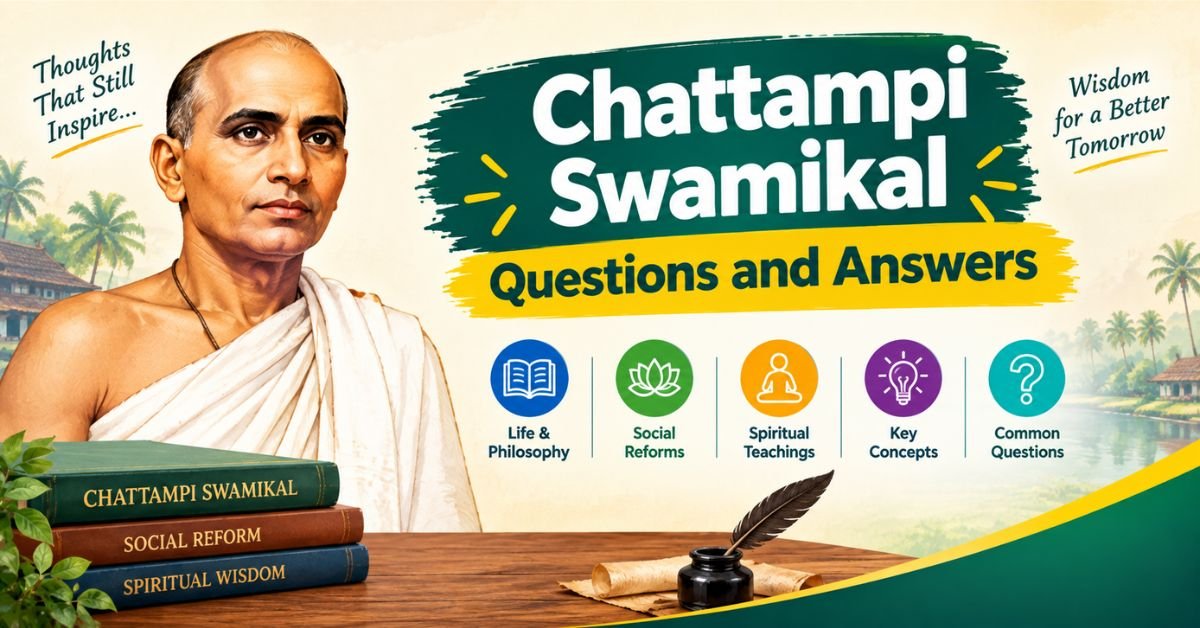
Chattampi Swamikal (1853–1924) remains one of the most searched names in Kerala’s history and general knowledge (GK) circuit, especially among Kerala PSC aspirants, school students, and readers of Kerala’s Renaissance history. Because his life spans philosophy, social reform, and literature, question papers pull facts from every corner of his biography — which is why “Chattampi Swamikal questions and answers” is such a high-intent search query.
This guide answers the most frequently asked questions about Chattampi Swamikal in one organized, fact-checked resource — verified against his English-language Wikipedia biography and repeated Kerala PSC question banks — so you don’t have to piece information together from scattered PDFs and quiz sites.
Who Was Chattampi Swamikal? (Quick Overview)
Chattampi Swamikal, born Ayyappan Pillai, was a Hindu sage, philosopher, and social reformer of 19th-century Travancore (present-day Kerala). He is remembered as one of the architects of the Kerala Renaissance, a movement that challenged caste rigidity, ritualism, and the monopolisation of knowledge by a privileged few. His most celebrated disciple was Narayana Guru, another towering figure of Kerala’s social reform history.
Quick Facts Table
| Category | Details |
|---|---|
| Birth name | Ayyappan Pillai (also called Kunjan Pillai) |
| Born | 25 August 1853, Kannammoola, Travancore |
| Died | 5 May 1924 (aged 70), Panmana, Travancore |
| Samadhi/Resting place | Panmana Asramam, Kollam district |
| Father | Vasudevan Namputhiri (Thamarassery Illam) |
| Mother | Nangamma (Veniyath family, Malayinkeezh) |
| Honorific title | Sree Vidyadhiraja Parama Bhattaraka Shanmughadasan |
| Philosophy | Advaita Vedanta |
| Famous disciple | Narayana Guru |
| Notable works | Advaita Chinthapaddhathi, Vedadikara Nirupanam, Pracheena Malayalam |
1. Early Life and Education: Questions and Answers
Q1. Where and when was Chattampi Swamikal born? He was born on 25 August 1853 at Kannammoola in southern Travancore, in present-day Thiruvananthapuram, Kerala.
Q2. What was Chattampi Swamikal’s original name? His birth name was Ayyappan Pillai, and he was affectionately called Kunjan Pillai in childhood.
Q3. Why is he called “Chattampi”? As a boy, he studied under the scholar Pettayil Raman Pillai Asan, who taught him without charging any fee. Because he was appointed monitor (leader) of the class, he earned the nickname “Chattampi” — a term used for a class monitor.
Q4. Did Chattampi Swamikal receive formal schooling? Not in the conventional sense. His family could not afford formal education, so he learned letters informally by listening to neighbourhood children recite their lessons, and he picked up Sanskrit by overhearing classes at a nearby Brahmin household — a detail frequently asked in exam quizzes.
Q5. Who introduced him to yoga? Thycaud Ayyavu Swamikal, a scholar and yogi associated with the intellectual group Jnanaprajagaram, introduced Kunjan Pillai to the science of yoga.
Q6. What is “Jnanaprajagaram”? It was a scholarly discussion group started in the 1870s by Raman Pillai Asan, bringing together experts from different disciplines. It became a key meeting point where the young Kunjan Pillai interacted with major intellectuals of his time, including Professor Manonmaniam Sundaram Pillai.
Q7. Why is he also known as “Shanmukhadasa”? A wandering sadhu once initiated him with the Balasubramanya Mantra, and his deep devotion to Lord Subramanya (Murugan) led him to adopt the name Shanmukhadasa.
2. Spiritual Journey and Gurus: Questions and Answers
Chattampi Swamikal’s spiritual quest is one of the most distinctive parts of his biography — he studied not only Hindu philosophy but also Christianity and Islam, an unusual and progressive approach for his era.
Q8. Who was Chattampi Swamikal’s principal guru in Vedanta? Subba Jatapadikal of Kalladaikurichin, Tamil Nadu, a renowned scholar of Tarka, Vyakarana, Mimamsa, and Vedanta, was his primary teacher. Swamikal studied under him for many years and mastered Tamil and Sanskrit shastras.
Q9. Did Chattampi Swamikal study other religions? Yes. After his Vedantic training, he lived with a Christian priest to study Christian theology, and later stayed with a Muslim scholar to study the Quran and Sufi mysticism — reflecting his belief that all religions lead to the same truth.
Q10. Where did Chattampi Swamikal attain self-realisation? He attained self-realisation under the guidance of an avadhuta (wandering ascetic) he met at Vadaveeswaram village in Tamil Nadu, with whom he lived in the forest for several months.
Q11. What philosophy did Chattampi Swamikal follow? He was a proponent of Advaita Vedanta (non-dualism), which he simplified for the common person through his writings.
3. Literary Works of Chattampi Swamikal
Chattampi Swamikal was a prolific writer across essays, bhajans, commentaries, and translations, though much of his work was lost because he lived a wandering life and left his manuscripts with whoever hosted him.
Q12. What are Chattampi Swamikal’s most important works? His best-known works include Advaita Chinthapaddhathi, Vedadikara Nirupanam, Vedanta Saram, Pracheena Malayalam, and Adi Bhasha.
Q13. What is “Vedadikara Nirupanam” about? It is considered his greatest and most radical work. It challenged the monopolisation of Vedic knowledge, education, and scriptures by a privileged minority — the first work in Kerala’s history to question this practice directly.
Q14. What is “Advaita Chinthapaddhathi”? Published in 1949 (posthumously), it is an introductory manual on practical Advaita philosophy, written in simple language so that people without Sanskrit knowledge could understand Vedantic concepts like Trigunas, Panchabhutas, and Tatvamasi.
Q15. What does “Pracheena Malayalam” discuss? It explores the origins of Kerala society, tracing a common ancestry for various communities of Kerala — including the priestly class — to build a collective regional identity.
Table: Key Literary Works of Chattampi Swamikal
| Work | Subject/Theme |
|---|---|
| Vedadikara Nirupanam | Critique of Vedic knowledge monopoly |
| Advaita Chinthapaddhathi (1949) | Simplified guide to Advaita Vedanta |
| Vedanta Saram / Vedantasangraham | Summary of Vedantic philosophy |
| Pracheena Malayalam | History and origins of Kerala society |
| Adi Bhasha | Study of ancient language roots |
| Christhumatha Saram / Nirupanam | Analysis of Christian religious tenets |
| Prapanchathil Stri Purushanmarkkulla Sthanam | Position of women and men in society |
| Nijananda Vilasam (translation) | Translation of Kodakanallur Sundara Swamikal’s Vedantic work |
4. Disciples and Social Influence: Questions and Answers
Q16. Who is Chattampi Swamikal’s most famous disciple? Narayana Guru, one of the greatest social reformers of Kerala, is widely regarded as his most influential disciple.
Q17. Who were Chattampi Swamikal’s other prominent disciples? His major disciples include Theerthapada Paramahamsa, Neelakanta Theerthapada, and grihastha (householder) disciples such as Bodheswaran, Perunnelli Krishnan Vaidhyan, and Kumbalath Sanku Pillai.
Q18. What did Chattampi Swamikal explain to Swami Vivekananda? He is credited with explaining the meaning of “Chinmudra” to Swami Vivekananda — a frequently asked PSC question.
Q19. What institution did his disciple establish following his teachings? His disciples established the Theertha Pada Matham, a line of sanyasins who followed Swamikal’s teachings and methods.
Q20. How did Chattampi Swamikal contribute to women’s emancipation? He argued that ancient Indian religion and law gave women equal status, and that it was later male-driven misinterpretation of scriptures that degraded women’s position in society — a progressive stance for his time.
5. Frequently Repeated Kerala PSC Questions on Chattampi Swamikal
Because Chattampi Swamikal is a recurring topic in Kerala PSC exams (LDC, LGS, Fireman, Police Constable, and degree-level exams), certain facts appear repeatedly. Here is a consolidated table of the most commonly tested questions.
| Question | Answer |
|---|---|
| Who is known as “Vidyadhiraja”? | Chattampi Swamikal |
| Who was known as “Shanmughadasan”? | Chattampi Swamikal |
| Which branch of medicine did he study? | Siddha medicine |
| Who explained “Chinmudra” to Swami Vivekananda? | Chattampi Swamikal |
| Who constituted the Theertha Pada Matham? | Chattampi Swamikal (through his disciples) |
| Where did Chattampi Swamikal attain samadhi? | Panmana, Kollam district |
| Who is Chattampi Swamikal’s most famous disciple? | Narayana Guru |
| What is his most radical/critical work? | Vedadikara Nirupanam |
| What philosophy did he follow? | Advaita Vedanta |
| In what year was he born? | 1853 |
6. Death and Legacy
Q21. When did Chattampi Swamikal pass away? He attained mahasamadhi on 5 May 1924, at the age of 70, in Panmana, Travancore (present-day Kollam district), after a brief illness during which he declined medical treatment.
Q22. What stands at his samadhi today? A temple dedicated to Lord Shiva now stands above his grave at Panmana.
Q23. Why is Chattampi Swamikal considered a Renaissance figure of Kerala? He challenged orthodox and ritualistic interpretations of Hindu texts, opposed caste-based restrictions on education, promoted vegetarianism and non-violence, and mentored reformers like Narayana Guru who went on to reshape Kerala’s social fabric.
Why These Questions and Answers Matter
Understanding Chattampi Swamikal is not only useful for competitive exams — it also provides insight into how Kerala’s social and religious landscape evolved during the colonial period. His ideas on open access to knowledge, gender equality, and religious harmony continue to be cited in academic discussions on Kerala’s intellectual history.
For students specifically preparing for Kerala PSC exams, a good revision strategy includes:
- Memorising key dates (birth, death, samadhi) using the quick facts table above.
- Linking disciple names to their contributions (especially Narayana Guru).
- Associating each major work with its central theme (see the works table).
- Practicing repeated PSC-style questions until recall becomes automatic.
- Cross-checking facts against a reliable, citation-backed source rather than uncredited quiz PDFs.
Frequently Asked Questions (FAQ)
Is Chattampi Swamikal the guru of Narayana Guru?
Yes, Narayana Guru is widely regarded as Chattampi Swamikal’s most prominent disciple, and Swamikal’s teachings significantly shaped Narayana Guru’s own reformist philosophy.
What language did Chattampi Swamikal write in?
He wrote primarily in Malayalam, with deep scholarship also expressed through Tamil and Sanskrit sources, since he was fluent in all three languages.
Was Chattampi Swamikal a sanyasi in the traditional sense?
He led a wandering, ascetic (avadhuta-like) life but did not always follow conventional monastic symbols; he is sometimes remembered as “the sanyasi without the ochre robe and kamandalu.”
What is Chattampi Swamikal Jayanti?
It is the birth anniversary of Chattampi Swamikal, observed on 25 August each year, and is marked by the Government of Kerala and various cultural institutions with lectures, seminars, and commemorative events.
Conclusion
Chattampi Swamikal’s life story — from a self-taught village boy to one of Kerala’s most influential philosophers — offers rich material for exam preparation, historical study, and personal inspiration alike. This questions-and-answers guide consolidates the most reliable, frequently tested, and biographically accurate facts about his life, works, gurus, and disciples in one place, so learners can revise efficiently without relying on fragmented or unverified sources.
Further Reading and Authoritative Sources
- Chattampi Swamikal — Wikipedia
- Narayana Guru — Wikipedia
- Kerala Department of Cultural Affairs, Government of Kerala
- Ayyavu Swamikal — Wikipedia
- Kannammoola — Wikipedia
You may also like : Top 10 Digital Marketing Institute in India, Best Digital Marketing Institute in India