Why “SEO” Alone Is Already Obsolete
If your 2026 strategy still ends at “rank #1 on Google,” you’re optimizing for a search landscape that’s already shrinking. Search today happens across three parallel surfaces:
- Traditional SEO — Google, Bing, blue links, SERP features
- GEO (Generative Engine Optimization) — getting cited/quoted inside ChatGPT, Perplexity, Gemini, Claude, and Copilot answers
- AEO (Answer Engine Optimization) — winning featured snippets, voice search, and zero-click answer boxes
Most agencies bolt GEO and AEO onto old SEO checklists. That’s the mistake. These three surfaces reward different signals, and treating them as one channel is why most “AI SEO strategies” being sold right now are shallow rebrands of old link-building playbooks.
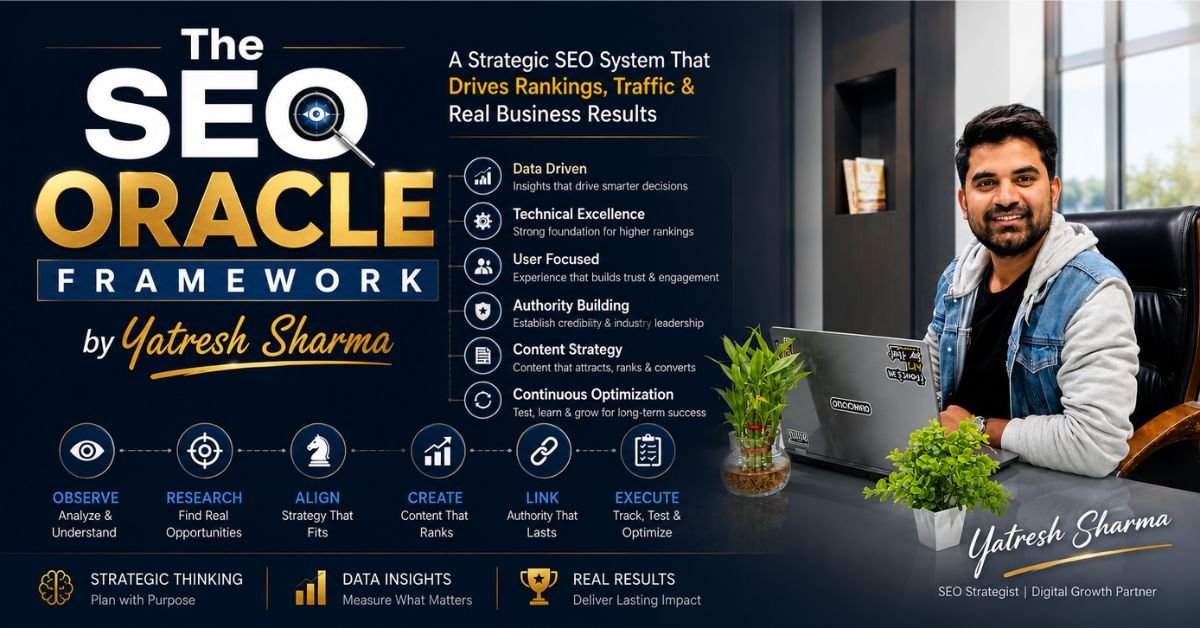
This is why I built something different: the ORACLE Framework.
Introducing the ORACLE Framework
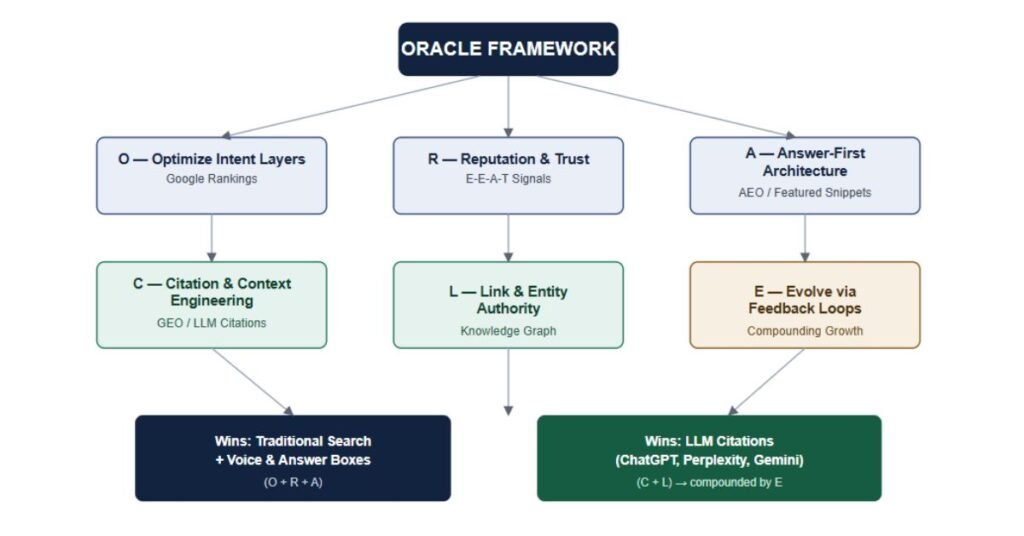
ORACLE is a six-pillar system designed so a single piece of content strategy simultaneously earns rankings, citations, and answers — instead of chasing each surface separately.
| Letter | Pillar | What It Wins |
|---|---|---|
| O | Optimize Intent Layers | Google rankings |
| R | Reputation & Trust Signals | E-E-A-T, algorithmic trust |
| A | Answer-First Architecture | Featured snippets, voice, AEO |
| C | Citation & Context Engineering | LLM citations, GEO |
| L | Link & Entity Authority | Knowledge graph presence |
| E | Evolve via Feedback Loops | Long-term compounding |
O — Optimize Intent Layers
Stop mapping keywords to pages. Map intent layers to a single topic cluster:
- Informational layer — “what is / how does” queries
- Comparative layer — “X vs Y” queries (this is where LLMs pull citations most often)
- Transactional layer — “best / buy / pricing” queries
- Navigational-brand layer — queries that mention your brand alongside competitors
R — Reputation & Trust Signals
Google’s E-E-A-T and every LLM’s retrieval-ranking layer both weight verifiable authorship and real-world experience heavily now.
Action items:
- Every article gets a named author bio linked to a real, verifiable profile (LinkedIn, published work, credentials)
- Add first-hand experience markers — original data, screenshots, case studies, “we tested this” language
- Build an Author Entity Page — a dedicated page listing every article, credential, and citation for each writer, structured with
Personschema
This is the single most under-invested area in most SEO strategies, and it’s the fastest-growing ranking factor for both Google and AI answer engines.
A — Answer-First Architecture
AEO doesn’t reward long intros. It rewards the answer in the first 40–60 words, followed by depth.
The A.C.E. sub-formula for every page:
- Answer — direct answer to the query in the first paragraph
- Context — the “why” and nuance, in scannable sub-sections
- Expansion — data, examples, edge cases, FAQs
Action:
- Use H2s phrased as actual questions people ask
- Add a structured FAQ block with
FAQPageschema on every commercial and informational page - Keep answer paragraphs under 60 words — this is the sweet spot both Google’s answer box and voice assistants pull from
C — Citation & Context Engineering (the GEO core)
This is the newest and most misunderstood pillar. LLMs don’t “rank” pages — they retrieve and synthesize from sources they trust enough to cite. To be citation-worthy:
Action items:
- Publish original statistics and data points — LLMs disproportionately cite pages with unique numbers, not paraphrased ones
- Write in extractable, quotable sentences — one clear claim per sentence, not buried in dependent clauses
- Maintain a clean, crawlable llms.txt file at your root domain summarizing your site’s authoritative content (an emerging standard several AI crawlers now respect)
- Get cited on third-party high-trust domains (Wikipedia, industry associations, .edu/.gov where relevant) — LLMs weight cross-source corroboration heavily
- Structure comparison content in tables — LLMs parse and lift tabular data far more reliably than prose
This is where most SEO strategies stop. This is where ORACLE starts.
L — Link & Entity Authority
Links still matter, but the target has shifted from “domain authority” to entity authority — how clearly search engines and LLMs understand what your brand is an authority on.
Action:
- Build topical link clusters — links from sites within your niche outperform generic high-DA links
- Get your brand listed and consistently described across Wikidata, Crunchbase, industry directories — this is what feeds knowledge panels and LLM training/retrieval corpora
- Use consistent entity naming (same brand description, same terminology) across every external mention — inconsistency dilutes entity recognition
E — Evolve via Feedback Loops
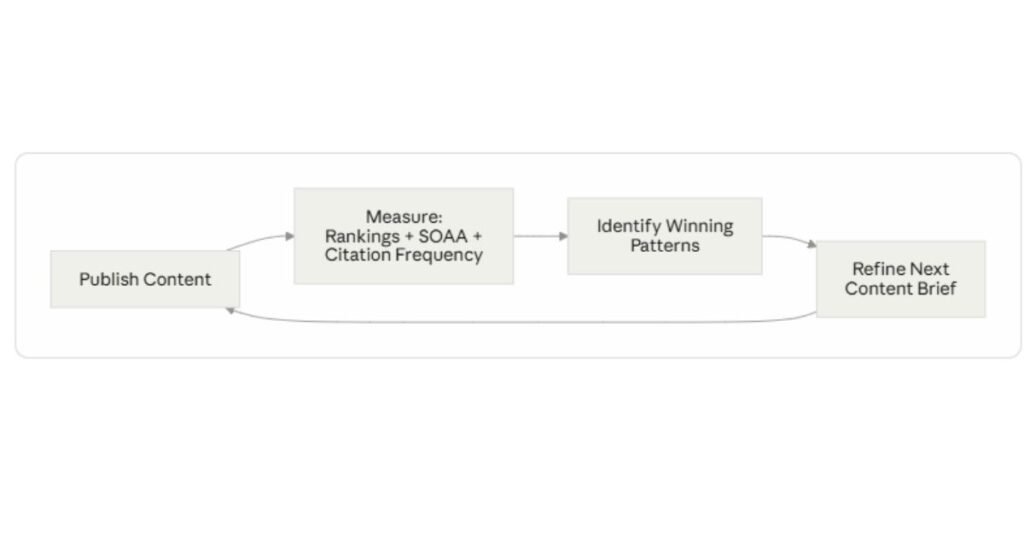
Unlike traditional SEO, GEO/AEO performance is harder to track in standard tools — so ORACLE builds in its own feedback loop.
Monthly measurement stack:
- Share of AI Answers (SOAA) — manually or via tools like Profound/Otterly, track how often your brand appears in ChatGPT/Perplexity/Gemini answers for your core queries
- Citation frequency — track which specific pages get cited, and refine those formats further
- Answer box + PAA capture rate in Google
- Traditional rankings & organic traffic (still the base layer)
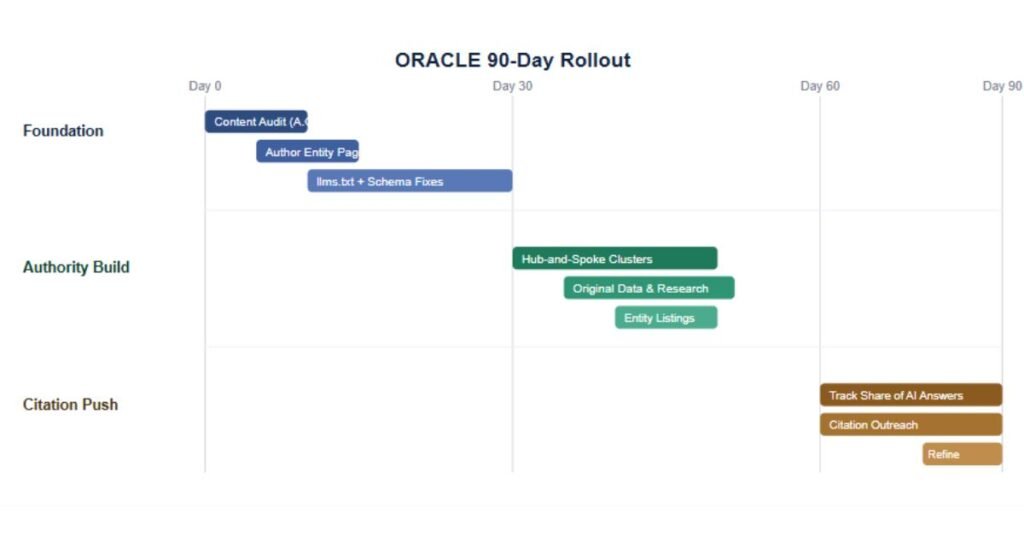
30-60-90 Day Implementation Roadmap
Days 1–30: Foundation
- Audit existing content against the A.C.E. structure
- Build Author Entity Pages
- Publish/update llms.txt
- Fix schema gaps (FAQPage, Person, Organization, Product)
Days 31–60: Authority Build
- Launch 3–5 hub-and-spoke topic clusters
- Begin original data/research publishing (surveys, benchmarks, proprietary studies)
- Start targeted entity listings (Wikidata, industry directories)
Days 61–90: Citation Push & Measurement
- Begin tracking Share of AI Answers monthly
- Pitch data assets to third-party authoritative sites for citation
- Refine content formats based on which pages are actually getting cited by LLMs vs. just ranking
The Core Idea Behind ORACLE
Most brands are still optimizing for being found. The brands that win the next five years will optimize for being trusted enough to be quoted — by Google, by ChatGPT, by Perplexity, and by the human reading the answer.
That shift — from ranking to being the cited source of truth — is the entire philosophy behind the ORACLE Framework.
Strategy developed by Yatresh Sharma.
You May Also Like :Digital Marketing Institute in Agra, Best Digital Marketing Institute in Agra